Subscribe to our newsletter
Copyright © 2026 lmitac.com All Rights Reserved. Contact - Terms and Conditions - Privacy Policy - Quality Policy - Vacancies - Sitemap
London Maritime Academy is a trade name for London Premier Group
version: 2.9.0
Subscribe to our newsletter

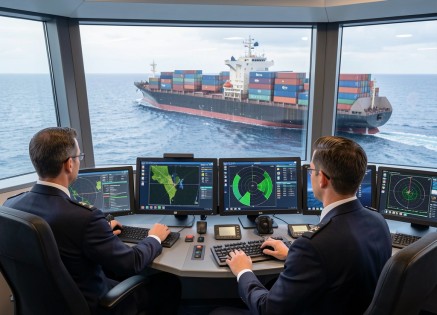
Discover how Cybersecurity at Sea is becoming essential for protecting modern vessels, digital navigation systems, and maritime operations from growing cyber threats, ensuring safer shipping, stronger resilience, and secure global maritime networks.
As modern shipping embraces rapid digitalization, AI(Artificial Intelligence), and IoT (Internet of Things), Cybersecurity at Sea has become a comprehensive critical sector priority, as the attack surface for maritime vessels expands across the operational domain, increasing challenges for the industry. In 2025 alone, cyber incidents surged by 103%, highlighting how vital it is to secure OT (Operational Technology) and navigational setup.
Cybersecurity at Sea is now essential to protect digital infrastructure, from GPS (Global Positioning System) spoofing to ransomware, as part of a regulatory step toward compliance with IACS UR E26/E27. These frameworks aim to enhance resilience across the maritime ecosystem and safeguard assets at sea. InfoSec (Information Security) at Sea is no longer optional but a “License to Sail,” reflecting its role as a core requirement across the maritime sector.
As vessels evolve into smart, connected configurations, Cybersecurity at Sea faces unique risks due to expanded connectivity and remote operations. This transformation introduces new actors and Threat vectors increasingly targeting Operational Technology systems such as engine controls, ballast operations setup, and ECDIS (Electronic Chart Display and Information System) platforms onboard vessels.
A major hazard involves GPS/GNSS spoofing, especially in high-risk regions affecting transport routes and naval corridors. These failures in navigation integrity demonstrate the extensive impact of cyber disruption on maritime safety.
Human users, including mariners, remain a critical vulnerability. Phishing and social engineering attacks exploit human error, while compromised credentials enable unauthorised access to the ship configuration. Supply chain risks also persist, with third-party updates posing systemic threats across fleets.
A pivotal aspect of InfoSec at Sea is strengthening detection mechanisms and crew awareness, enabling operators to identify threats early. This action is essential for maintaining seaworthiness and reducing exposure to cybercrime.
Digital attacks demonstrate how Cybersecurity at Sea directly affects physical operations. Manipulation of navigation systems can lead to collisions, groundings, and disruptions to global trade routes, raising serious defence and safety implications.
The 2025 grounding of MSC Antonia illustrates how spoofing can mislead vessels, while the NotPetya attack on Maersk showed how a single incident can paralyse global logistics networks. These events provide insights into how cyberattacks propagate through maritime structures. Business authors and leaders across Europe emphasise that these risks require coordinated response frameworks on the international level.
A key event in the discussions highlighted the need for stronger national coordination following threats identified across multiple fleets.The Maersk incident remains a defining event that shaped awareness, pushing organisations to develop actionable recovery strategies and improve resilience across maritime networks.(IMO, 2022; ICS et al., 2024; ENISA, 2025)

Modern Maritime Cybersecurity Regulations are being shaped by IMO (International Maritime Organization), EU NIS2, and USCG United States Coast Guard frameworks. These require a unified InfoSec approach across IT (Information Technology) and OT setup.
IMO guidelines promote risk-based management, ensuring response and recovery capabilities are embedded into Safety Management Systems. IACS (International Association of Classification Societies) UR E26 and E27 strengthen shipboard resilience by securing system architecture and computerized functions. A Ship Security Assessment (SSA) is a mandatory ISPS Code risk-based analysis identifying vessel vulnerabilities, ensuring proactive protection against threats to maintain compliance, safety, and security.
Effective Maritime Cybersecurity requires layered defenses and continuous improvement:
A strong security culture allows organizations to enhance resilience and improve operational readiness across fleets.
This pivotal shift ensures maritime teams are prepared to learn continuously and respond effectively to evolving threats and concerns.
The future of Cybersecurity at Sea depends on coordinated international action, sophisticated technological advancement, and workforce readiness. Maritime stakeholders must continue seeking stronger protections to defend against emerging threats.Through collaboration between governments, industry leaders, and InfoSec experts, the sector can build a more secure digital maritime environment. Ultimately, Cybersecurity at Sea is about ensuring safety,resilience, and trust across Comprehensive shipping networks. It is a shared responsibility requiring continuous vigilance, innovation, and cooperation across the entire maritime ecosystem.
LMA gives you the opportunity to expand your knowledge through Maritime security training
courses in Dubai and in our 8 facilities around with various other security related courses like CSO (Company Security Officer) and PFSO (Port Facility Security Officer) Training .The digital world is fast and waits for no one, and you must constantly develop your skills to catch up before it is too late. Remember: LMA team of experts is always by your side. Do not hesitate to contact us!