
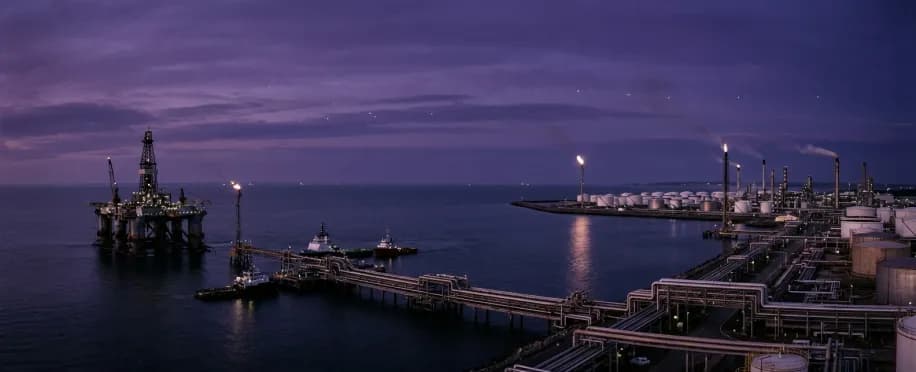
The division of the oil and gas industry into upstream, midstream, and downstream sectors defines how hydrocarbons progress from underground reservoirs to refined consumer products. Upstream focuses on exploration and production; midstream manages logistics, pipelines, and storage; and downstream handles refining, processing, and final distribution. Understanding how these distinct stages interact enables energy executives and investors to evaluate capital allocation, manage sector-specific operational risks, and identify value creation across the entire supply chain.
Upstream vs midstream vs downstream describes the three stages that move oil and natural gas from underground reserves to usable products. Upstream finds and produces resources. Midstream moves them. Downstream processes and sells them. The distinction shows where investment, risk and commercial value sit across the energy chain.
Each stage depends on the next. Production needs transport capacity, while refineries need reliable feedstock. These relationships reveal the key differences and show why decisions in one area can affect another.
Follow the resource from reservoir to customer.
| Stage | Core role | Typical activities | Business focus |
| Upstream | Find and produce | Exploration, drilling and production | Reserves and recovery |
| Midstream | Move and store | Pipelines, terminals and transportation | Capacity and reliability |
| Downstream | Process and sell | Refining, distribution and marketing | Yield, margins and demand |
These oil and gas sectors form a sequence. Their roles change as the resource moves forward: upstream creates supply, midstream moves it, and downstream converts it into usable products.
Upstream oil and gas covers exploration and production, often shortened to E&P. Companies identify resources, evaluate reservoirs, drill wells and operate producing assets.
This stage carries geological and capital risk. A company may invest heavily before knowing whether a discovery can support commercial production. These challenges make reservoir quality and development cost central to decisions.
Offshore operations make that complexity visible. Floating production systems can combine processing, storage and export functions. Understanding how FPSOs operate in offshore oil and gas shows how production infrastructure adapts when fixed facilities are impractical.
Drilling can also require specialised assets. Mobile offshore drilling units and how they work illustrate how operators select units according to water depth and field conditions.
But bringing hydrocarbons to the surface is only the first milestone. Operators then face another question: how will that crude or gas reach the next buyer or facility? That handoff takes the business into midstream.

Midstream connects producing assets with refineries, storage hubs and export terminals through pipelines, gathering systems and marine transportation.
This role can determine whether production moves smoothly or becomes constrained. A field may have strong output potential, but limited pipeline or terminal capacity can restrict access to market. For international crude movements, understanding different types of oil tankers and their roles helps companies match vessel capacity with particular trade routes.
Once hydrocarbons reach the right location, the commercial question changes again. The focus shifts from movement to conversion and market value.
Downstream oil and gas covers processing, refining, distribution and marketing activities closer to the customer. Refineries convert crude into fuels and other usable products, while distribution networks move them toward buyers.
Crude oils behave differently in a refinery. Feedstock characteristics influence processing requirements and the product mix that can be produced profitably.
Downstream performance therefore depends partly on earlier decisions in the chain. Upstream output affects refinery input, while midstream reliability determines whether suitable feedstock arrives at the correct facility on time.
Seen this way, upstream vs midstream vs downstream becomes more than an industry classification. It helps managers trace problems across the system. A refinery constraint may appear downstream while its cause sits in transportation capacity or upstream supply.
Comparing upstream vs midstream vs downstream reveals different investment profiles. Upstream businesses manage exploration uncertainty and production economics. Midstream operators focus on infrastructure utilisation. Downstream businesses work closer to product demand and processing margins.
The commercial connection matters just as much as the differences. Higher production creates little value without takeaway capacity, while refinery performance relies on suitable feedstock.
These links explain why innovations shaping the industry’s chain can affect each stage differently. Digital reservoir modelling can improve upstream decisions; monitoring technology can strengthen midstream reliability; process optimisation can improve downstream efficiency.
Professionals who learn how these handoffs work can evaluate projects more effectively. The Fundamentals of Oil & Gas Exploration and Production course provides a foundation for understanding exploration and production within that system.
Some companies specialise in one part of the value chain, while integrated businesses span several stages. This can provide greater control over movement from production to sale.
Integration does not remove the distinctions. A producing asset, pipeline network and refinery have different capital requirements, risk profiles and revenue drivers. Understanding upstream vs midstream vs downstream helps leaders see where business units depend on one another and where bottlenecks could affect performance.
For investment decisions, ask: where is value created? Which infrastructure does the project depend on? What could restrict capacity? Which market determines the return?
Understanding upstream vs midstream vs downstream shows how hydrocarbons move from the reservoir to the market. Each stage creates a different form of value, yet performance depends on the handoffs between them.
For leaders assessing investment or operational risk, the framework shows where dependencies sit and which connection may determine whether an asset delivers its expected return.
No related Articles yet.