Subscribe to our newsletter
Copyright © 2026 lmitac.com All Rights Reserved. Contact - Terms and Conditions - Privacy Policy - Quality Policy - Vacancies - Sitemap
London Maritime Academy is a trade name for London Premier Group
version: 2.9.0
Subscribe to our newsletter
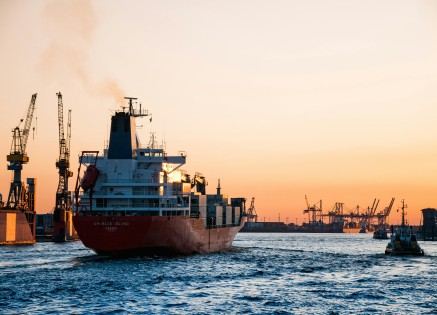
The true measure of the ISPS Code isn't found in approved paperwork, but in how effectively a vessel and port facility turn security plans into real-world protection. From gangway access control to navigating changing security levels, this article breaks down how maritime professionals can execute ISPS requirements to ensure crew safety without sacrificing operational efficiency.
International Ship Security and Port Facility (ISPS) Code shipping is clear evidence of whether a vessel and port facility can turn security plans into real protection. What matters is to have the access control functions properly; threats are recognised and ensure that the crew knows what to do when situations change.
In this article, we explain how the ISPS Code works; who is responsible for what; what the three security levels mean; where ships commonly fail; and how professionals can prepare without treating security as a paperwork exercise.
The Code forms part of SOLAS Chapter XI-2 and became mandatory on 1 July 2004. The International Maritime Organization (IMO) divides it into Part A, which contains mandatory provisions, and Part B, which provides guidance on implementation.
At its core, ISPS Code shipping asks a simple operational question: what could threaten this ship or port facility, and what controls are needed to reduce that risk?
The answer must be reflected in daily operations. A company may have certificates, policies, and approved plans, yet security still depends on what happens at the gangway, around restricted areas, during cargo handling, and when an unusual situation develops.
The main requirements include:
The requirements behind the ISPS security framework therefore reach far beyond documentation. They influence how crew members, companies, terminals, government authorities, and designated facility personnel work together during routine operations.
A ship does not operate in isolation. Its security arrangements have to connect with the company ashore and with the facility receiving the vessel.
That becomes especially clear during a port call. The Ship Security Officer (SSO) may need to verify visitors, coordinate with the terminal, monitor restricted areas, check store deliveries, and confirm that the vessel is following the required security level.
The company also has responsibilities. It must support implementation, designate appropriate personnel, maintain plans, and make sure the ship has the resources needed to comply with applicable regulations.
Then there is the Master. SOLAS XI-2 protects the Master's authority to make decisions necessary for the safety and security of the vessel. Commercial pressure should never override a decision made to protect the ship when a credible threat exists.
This division of ownership matters because a weak link ashore can quickly become a problem onboard.
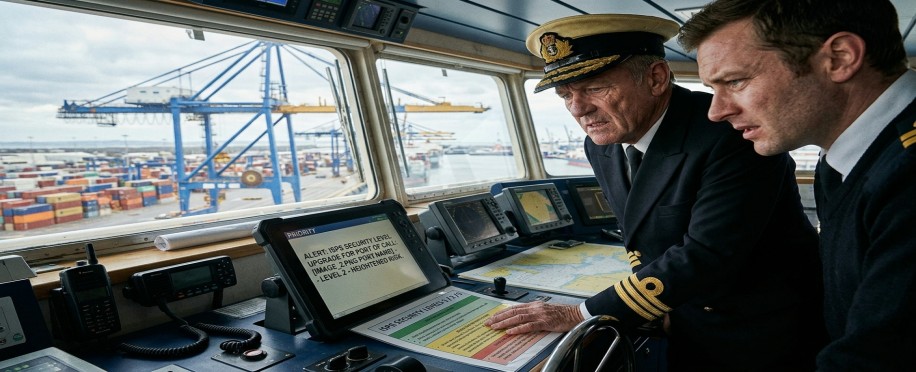
The framework uses three security levels. These levels allow ISPS Code shipping controls to increase when risk increases.
| Security level | Meaning | What changes operationally |
| Level 1 | Normal operating conditions | Standard protective measures remain in place |
| Level 2 | Heightened risk | Additional checking, monitoring, and restrictions are introduced |
| Level 3 | Probable or imminent threat | Exceptional protective measures are applied for a limited period |
At Level 1, your team follows the normal approved procedures. At Level 2, additional measures may affect access, patrols, identification checks, restricted spaces, cargo supervision, or communication with the facility.
Level 3 is different again. The threat is considered probable or imminent, so specific instructions may come from the relevant authorities and it might strongly lead to evacuation.
Why does this distinction matter? Because crews need to understand exactly what changes when the level changes. The IMO's guidance on maritime security levels and ship-port responsibilities makes clear that ships may also need to comply with a higher level established by the government of the port they are entering.
Before you can decide which controls are appropriate, you need an accurate picture of the vessel's exposure.
A ship security assessment should examine how someone might gain unauthorised access, which areas are critical, where surveillance may be weak, and which operations create additional vulnerability. It should also consider communications, cargo handling, stores, emergency arrangements, and credible threats.
The important word here is current.
If the vessel changes its route, equipment, trading pattern, layout, or operating environment, the risk picture can change with it. Your assessment should reflect the ship you operate now rather than the ship described several years ago.
That is why Ship Security Assessment (SSA) is directly connected to the controls written into the security plan. The assessment identifies exposure. The plan then defines what your team will do about it.
A comprehensive assessment also supports better decision-making during inspections and internal reviews. It gives the organization a detailed record of why specific security measures were selected and where further development may be needed.
An approved Ship Security Plan (SSP) can be comprehensive and detailed, but its real value appears when your crew has to use it.
Consider a merchant vessel arriving at a port operating at Security Level 2. The crew is handling stores. Contractors need access. Cargo operations are beginning. At the same time, the facility introduces tighter controls.
What happens next?
The Ship Security Officer should know which measures apply. Watchkeepers should understand who may board. Restricted areas should remain controlled. Communication with the facility should be clear. Required records should be maintained.
Therefore, implementing the ISPS Code becomes part of normal shipboard management, because procedures must continue to function during changing crews, busy port calls, operational pressure, and different terminal arrangements.
For marine operations teams, consistency is essential. Security provisions that are interpreted differently from one voyage or facility to another can create confusion at exactly the point when quick decisions are needed.
Security measures protect ships and ports, but implementation can add work. More checks can mean more documentation. Tighter access controls may require additional personnel. New equipment can create capital and maintenance costs.
You therefore have to manage both protection and operational efficiency.
Research supports this concern. According to Impacts of the ISPS Code on Port Activities: A Case Study on Swedish Ports, implementation improved control of port areas and reduced unauthorised access, while ports also reported increased paperwork, administrative work, and operating expenses. The study supports an important management point: stronger security can improve control, but poorly designed processes can also add unnecessary friction.
For shipping companies, this means compliance should be designed into existing operations. If every measure creates a separate administrative process, costs can rise without producing an equivalent improvement in protection.
The same applies to commercial charges. A delay caused by missing documentation, inspection issues, or additional control measures may eventually create extra port costs, a charge from another party, or even a surcharge elsewhere in the logistics chain.
For a carrier working across several ports, these delays can affect berth planning, cargo connections, customer commitments, and wider global trade schedules.
A plan cannot recognise suspicious behaviour. Your people do that.
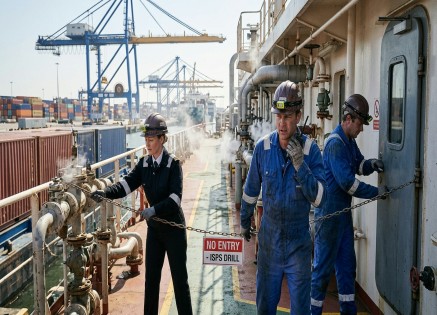
Crew members need to know what they are responsible for, what they should report, and how their duties change across security levels. They should also understand the difference between routine activity and behaviour that requires escalation. A drill gives you a controlled way to test whether responsibilities, communications, equipment, and procedures actually work.
A useful drill should leave you with clear lessons. If the same weakness appears repeatedly and no corrective steps follow, the exercise has little value.
Exercises can also enhance coordination between shipboard teams and shore personnel. When everyone understands the same procedures and escalation steps, the response becomes clearer during high-pressure situations.
For officers taking designated onboard responsibilities, the ISPS Code: Ship Security Officer Course , Port Facility Security Officer (PFSO) and Company Security Officer (CSO) Courses covers the knowledge needed to manage security plans, drills, reporting, threat response, and coordination with port facilities.
Before the next port call, ask questions that test actual readiness rather than paperwork alone:
These steps also help management identify where additional training, equipment, or procedural development may be required.
They are particularly useful when operating across multiple facilities, because individual ports may apply local security arrangements within the wider international regulation and national government requirements.
ISPS Code shipping gives you a structured way to identify threats, assign responsibilities, control access, adjust security levels, and coordinate with the port facility.
For management, the test is straightforward: can the ship demonstrate that its procedures work during normal operations and when conditions change? When assessments stay current, crews understand their duties, and plans are tested properly, compliance becomes easier to manage and security decisions become faster and more consistent.