Subscribe to our newsletter
Copyright © 2026 lmitac.com All Rights Reserved. Contact - Terms and Conditions - Privacy Policy - Quality Policy - Vacancies - Sitemap
London Maritime Academy is a trade name for London Premier Group
version: 2.9.0
Subscribe to our newsletter
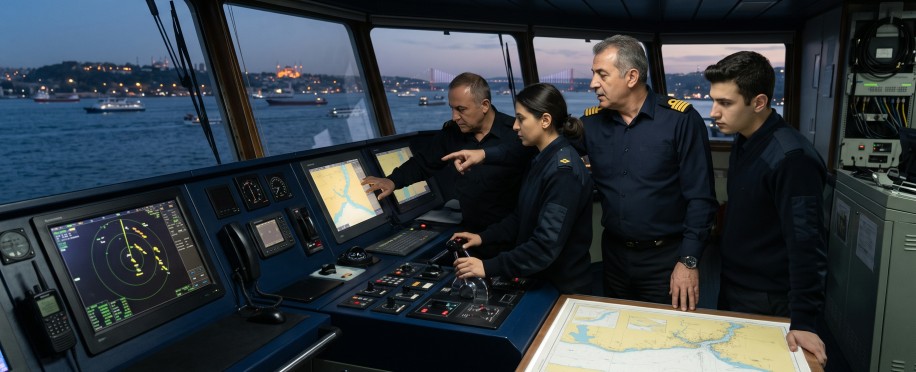
Maritime training in Istanbul offers professionals a practical route to developing maritime skills within one of the world’s busiest shipping environments. With the Bosphorus connecting Europe and Asia, the city provides valuable context for navigation, shipping operations, safety, logistics, and maritime career development.
Maritime training Istanbul is most useful when it connects professional education with the real life hands-on training in a major shipping location. Istanbul is located beside the Bosphorus, where commercial traffic and pilotage are part of daily operations. That gives professionals a practical setting for understanding how maritime decisions affect safety and business performance.
In this article, we explain which training routes fit different careers; why Istanbul matters as a maritime focal point ; how to evaluate the course quality; and what to cover before investing in a programme.
Istanbul connects the Black Sea with the Sea of Marmara through one of the world’s most important natural waterways. Turkey’s Ministry of Transport and Infrastructure reported that more than 40,000 ships transited the Istanbul Strait in 2025.
For someone considering maritime training in Istanbul, that environment provides useful context. Vessel movements are affected by traffic density. Weather can change schedules. Pilotage becomes important in constrained waters. Delays can also affect commercial commitments further along the route.
However, geography alone does not make a course valuable. But the programme still needs clear outcomes and experienced instructors. It also needs practical assessment that matches the learner’s role.
Start with the job you want next rather than the academy you recognise first. A cadet preparing for sea service needs different education from a superintendent who already manages people and vessels.
| Career goal | Useful training focus | Practical benefit |
| Work at sea | Navigation or marine engineering | Builds technical competence |
| Move into management | Shipping operations or leadership | Supports wider responsibility |
| Enter logistics | Port operations or supply-chain studies | Connects cargo movement with business |
| Build offshore skills | Safety or technical programmes | Supports specialist work |
| Progress academically | University maritime studies | Creates a broader education pathway |
Istanbul Technical University’s Maritime Faculty offers education in Maritime Transportation and Management Engineering as well as Marine Engineering Operations. Its facilities also include simulators and training vessels.
This is where maritime training Istanbul becomes more useful when selected carefully. The right programme should prepare you for a specific responsibility rather than simply add another certificate to your CV.
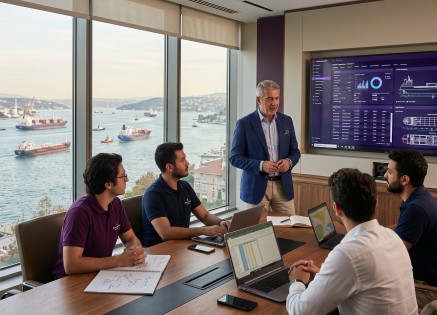
Turkey maritime training includes university programmes. It also includes professional certification and shorter industry-led courses.
That wide range matters because maritime careers rarely follow one fixed path. A deck officer may later move into shore-based operations. A Maritime Engineer may progress into fleet management as a technical superintendent . A logistics professional may need deeper knowledge of vessel activity before taking on a port-facing role.
If your technical knowledge is already strong, you may benefit more from management or commercial education. If you are moving into offshore work, the priority may be safety or specialist operational competence.
Before registering, ask one question: what will I be able to do better after this class?
Bosphorus shipping courses are most valuable when they use the waterway as a real operational case. The Istanbul Strait includes narrow sections and strong currents. It also handles busy vessel traffic.
That is where the city’s maritime setting can offer more than generic education. The surrounding environment gives instructors practical material that can be connected to real shipping decisions.
A course can use Bosphorus operations to examine what happens when navigation pressure affects schedules. It can also show how operational decisions influence safety or commercial performance. This gives learners a clearer connection between technical knowledge and the consequences of inappropriate use .
A polished website tells you very little about educational quality.
A strong maritime academy should explain what the learner is expected to achieve. It should also be clear about instructor experience and assessment methods. Certification value should be easy to verify.
Before enrolling, check:
Private providers can also play a useful role when they focus on specialist development. Poseidon Maritime Academy is one example of a private training center operating in Istanbul. As with any provider, professionals should verify recognition for their flag or employer before paying.
Quality matters particularly when a programme is designed around a regulated maritime responsibility. A certificate from an academy may confirm that you completed a class. However, it does not automatically mean the qualification satisfies every flag State or company requirement.
Training becomes valuable when it changes how you can handle it at work.
After a programme, apply one lesson to a real task. You might improve a voyage report. You could strengthen an emergency drill. You may review a maintenance process that causes repeated delays.
Then document the result.
The guide to building a maritime career through training in Istanbul can help professionals compare development routes according to role and career stage.
Most importantly, maritime training Istanbul should leave you with evidence of improvement. That might mean fewer reporting errors. It could mean better communication during an operation. It may also mean faster decisions during a disruption.
Why is that important?
When you apply for promotion, saying that you completed a course tells an employer what you studied. Showing how you improved an operational process tells them what you can actually do.
That distinction can make training far more valuable to your career.
Before registration, confirm the total time commitment. Check the class format. Ask how assessment works. Then verify whether the certificate supports the role you are targeting.
Relevant Istanbul maritime training courses can help professionals explore development options in a major regional shipping center.
However, do not choose a programme only because it is based in Istanbul. Compare the syllabus with your current responsibilities and your next intended role.
A strong programme should explain what you will learn. It should also show how the learning will be tested and where those skills can be used in practice.
If simulation is advertised, ask how it is used. Watching a demonstration is different from making decisions inside a simulator and receiving feedback afterwards.
The same applies to industry-led education. Ask who leads the course and how recently that person worked with the subject being taught. Current professional experience can make the difference between general theory and useful operational insight.
Companies benefit most when training addresses a defined capability gap. Stronger navigation knowledge can reduce operational risk. Better management skills can improve coordination.
For a shipping company, maritime training Istanbul works best when the expected outcome is agreed before the programme begins. That makes performance easier to measure.
For example, an employer may send a marine professional for management education because that person is preparing to lead a larger team. In that situation, the expected result should involve stronger supervision or clearer decision-making rather than course attendance alone.
This approach also helps companies build development plans. Training becomes part of workforce development instead of an isolated education expense.
Before you commit, ask:
These questions help separate strong programmes from courses that rely mainly on marketing.
They also make comparison easier. Two courses may have similar titles while offering very different levels of depth. One may focus on introductory knowledge while another expects previous experience and concentrates on complex operational decisions.
Maritime training Istanbul gives professionals access to education within a city shaped by international shipping and the Bosphorus. The real value, however, comes from choosing carefully.
Compare the content. Verify recognition. Check instructor experience. Look for practical assessment and make sure the programme supports your next responsibility.
For employers, stronger training can improve operational capability and succession planning. For individuals, maritime training Istanbul should turn education into stronger judgement and evidence that you are ready for greater responsibility.