Subscribe to our newsletter
Copyright © 2026 lmitac.com All Rights Reserved. Contact - Terms and Conditions - Privacy Policy - Quality Policy - Vacancies - Sitemap
London Maritime Academy is a trade name for London Premier Group
version: 2.9.0
Subscribe to our newsletter
Posted On: 5/15/2026, 7:12:58 PM
Last Update: 5/15/2026, 7:12:58 PM
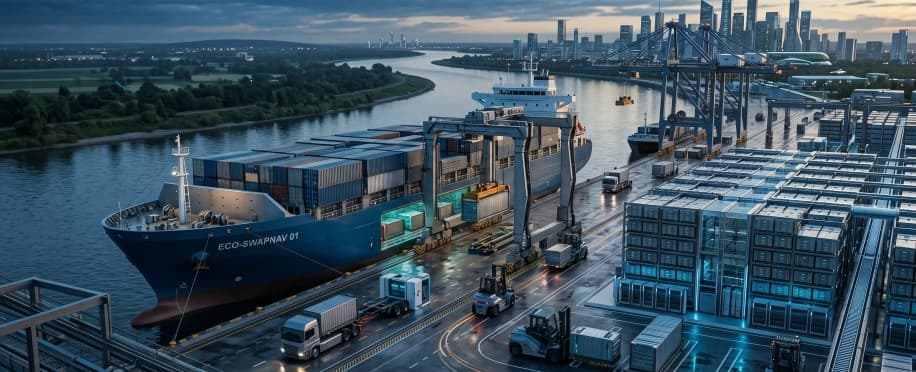
After completing its first cargo trip between Wuhu Port and Chaohu Port in Anhui Province, China officially launched the first standard modular battery-swapping ship in history.
The ship, known as Hefu Weilan 01, safely arrived at Chaohu Port and finished the unloading process after leaving Wuhu Port with 49 standard containers.
Wuhu Shipyard Co., Ltd. and Sandianshui New Energy Technology Co., Ltd. collaborated to build the vessel, which has a deadweight tonnage of 3,000 tonnes and a top speed of 8 knots.
Designed for inland waterway transport, the ship employs a standard modular battery-swapping system rather than traditional marine fuel systems. It is equipped with six modular batteries, each holding a capacity of 430 kWh.
Moreover, a single battery can be swapped in around five minutes, and all six batteries can be replaced within 30 minutes.
The vessel, launched in Wuhu on 28 April 2025, received battery-swapping system certification and ship inspection certificates from the China Classification Society, along with Approval in Principle certificates from Bureau Veritas and DNV over the past year.
The International Association of Classification Societies counts all three institutions among its members.
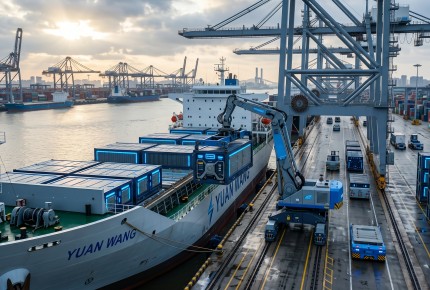
Besides, the vessel's acceptance from the three classification organisations demonstrated a great international reputation within the maritime sector, according to Zheng Tianbao, Deputy General Manager of Wuhu Shipyard.
Following certification by the China Classification Society, the vessel was designated as the world's first standard modular battery-swapping ship.
Maritime Engineering Courses investigates the Standard Modular Battery-Swapping Ship, which employs ISO-standardised, containerised battery modules that can be physically lifted and swapped in minutes. This removes multi-hour charging downtimes, transforming long-haul maritime transport into a "high-speed rail on water" that allows for continuous operations.
According to Liu Yang, executive vice president of Sandianshui New Energy Technology Co., Ltd, the vessel's core system is a modular battery-swapping platform that enables batteries to be shared among ships, vehicles, and storage.
This allows batteries on ships to be used ashore for port-heavy trucks, forklifts, and industrial energy storage operations.
Meanwhile, the company aims to create a unified energy system centred around ports, utilising the same battery infrastructure across various transport and industrial sectors.
The battery-swapping system has been applied for over 370 patents across various technical areas, incorporating several technologies from the automotive industry.
The ship represents a pioneering achievement as the first to integrate an automotive-grade motor sourced through an innovative electric vehicle supply chain. Its design aims to enhance driving efficiency while concurrently minimising weight, cost, and energy consumption.
Further, the ship features a cohesive electronic and engine management system that utilises intelligent cockpit concepts, similar to those found in vehicles.
A 360-degree surround-view collision avoidance system, visual improvement features, and pre-installed hardware for upcoming automated berthing and unberthing procedures are additional features.
As China continues to promote low-emission inland waterway transport, the project creators indicated that the vessel's commercial operation would facilitate the implementation of the shared modular battery-swapping technology across more inland shipping routes and port operations.
Read more news: