Subscribe to our newsletter
Copyright © 2026 lmitac.com All Rights Reserved. Contact - Terms and Conditions - Privacy Policy - Quality Policy - Vacancies - Sitemap
London Maritime Academy is a trade name for London Premier Group
version: 2.9.0
Subscribe to our newsletter
Posted On: 8/21/2026, 10:17:55 AM
Last Update: 8/21/2026, 10:17:55 AM
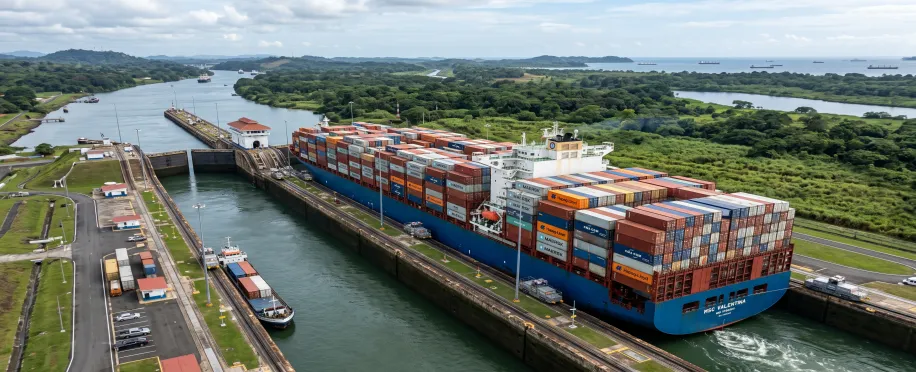
After a severe drought that disrupted operations in 2023 and 2024, vessel traffic has recovered, marking 112 years since the Panama Canal opened on August 15. However, as El Niño intensifies, the waterway's freshwater supply is once again under pressure.
According to the Panama Canal Authority (ACP), the canal saw 10,623 deep-draft vessel transits during the first ten months of the fiscal year 2026. Compared to 10,010 transits during the same time last year, that was 6.1% more.
The increase indicates that 613 additional vessels utilised the canal from October 2025 to July 2026, reflecting heightened demand following drought-related shipping restrictions in the prior two years. Concurrently, the ACP has begun to lower the maximum draft for Neopanamax vessels due to declining water levels in Gatun Lake.
The maximum authorised draft for the canal decreased from 49.5 feet in early July to 48.5 feet by August 15, with further reductions planned to 48 feet on August 26 and 47.5 feet from September 3. Despite these restrictions, the canal has not reduced its daily transit slots, and the measures are less severe than those during the 2023-24 drought.
The Panama Canal, opened on August 15, 1914, is a 77-km waterway connecting the Atlantic and Pacific oceans, impacting 170 countries. It integrates 180 shipping routes and approximately 1,920 ports globally, handling 3% to 5% of maritime trade.
Moreover, the canal significantly reduces travel distance for ships, saving about 15,000 km on U.S. coast-to-coast routes and around 3,700 km between Europe and East Asia.
The ACP estimates that cargo through the canal represents about $444 billion in annual trade value. In fiscal year 2025, vessels accounted for approximately 489.2 million PC/UMS tons, with average daily traffic rising from 34 to 37 vessels. The canal generated roughly $5.7 billion in revenue and contributed an estimated $4.2 billion to Panama's economy, about 3.4% of GDP, supported by over 9,000 employees.
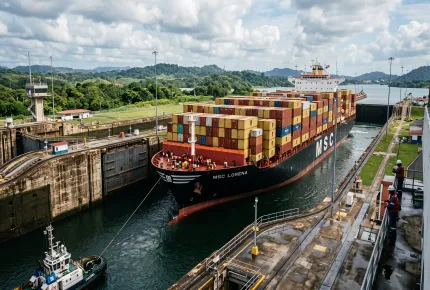
The tenth anniversary of the canal's enlarged locks, which opened in June 2016, highlights their significance, with over 31,000 ships using them by May. Neopanamax operations contributed to more than half of the canal's total revenue. In the first ten months of fiscal 2026, 2,990 deep-draft vessels used the Neopanamax locks, compared to 7,633 Panamax vessels.
Before ships enter Gatun Lake, the canal's lock system lifts them to a height of roughly 26 meters above sea level. Locks on the opposite side then lower ships back to sea level.
Typically, a full passage takes eight to ten hours. The waterway is managed by the independent public Panama Canal Authority, which employs dynamic pricing based on demand and seasonal water levels.
The ACP aims to enhance the canal's functions beyond ship transit by envisioning Panama as a logistics, energy, and maritime services hub in its 2025-2035 strategic plan.
Likewise, two container transhipment terminals are under development in Corozal and Telfers to improve Panama's container-handling capacity and global shipping connections. A proposed 76-km pipeline plans to create an Energy Corridor linking the Atlantic and Pacific coasts.
The pipeline will transport propane, butane, and ethane across the country, enabling energy cargoes to bypass the canal's locks. This project is anticipated to generate new revenue sources and enhance the economic value of cargo transiting through Panama.
Maritime Engineering Courses focus on the canal industry, encompassing civil engineering, water resource management, and economic infrastructure. Canals play diverse roles such as freight transport, agricultural irrigation, flood control, and urban wastewater management.
The canal implemented water-saving measures in late 2025 due to upcoming pressure on freshwater resources. Measures include expanded use of water-saving basins at Neopanamax locks, simultaneous lockages for smaller vessels, and interior lock gates to lessen water consumption. Furthermore, hydroelectric generation at Gatun Dam has been restricted to conserve freshwater.
During the dry season, favourable conditions helped build reserves in the Gatun and Alhajuela reservoirs. This comes after the 2023-24 drought, which saw low Gatun Lake levels that necessitated reduced daily transits and stricter draft limits, resulting in increased shipping costs and some carriers opting for alternative routes.
The ACP is evaluating the proposed Rio Indio reservoir to ensure sufficient water for canal operations and Panama's population. It continues to monitor lake levels and climate forecasts, planning to implement operational adjustments as necessary.
In closing, the 1977 Neutrality Treaty grants the waterway a unique legal status, permitting warships from all nations to transit the canal without the need for inspection, search, or surveillance.