Subscribe to our newsletter
Copyright © 2026 lmitac.com All Rights Reserved. Contact - Terms and Conditions - Privacy Policy - Quality Policy - Vacancies - Sitemap
London Maritime Academy is a trade name for London Premier Group
version: 2.9.0
Subscribe to our newsletter
Posted On: 7/23/2026, 10:40:33 AM
Last Update: 7/23/2026, 10:40:33 AM
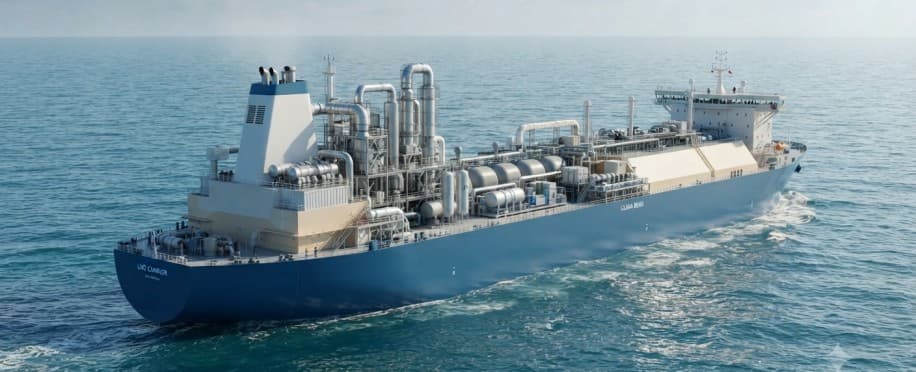
Two regulatory frameworks have recognised a project run by the Global Centre for Maritime Decarbonisation (GCMD), which may hasten the use of onboard carbon capture and storage (OCCS).
The International Maritime Organisation (IMO) has given Project Captured in-principle support and recognition under the EU Emissions Trading System (EU ETS) for carbon mineralisation as a long-term carbon dioxide (CO₂) storage method.
As long as the CO₂ is permanently bound in qualified products, the EU ETS recognition allows verified volumes of CO₂ captured onboard ships to be subtracted from a vessel's reported emissions, lowering the number of EU Allowances operators must surrender.
CEO of GCMD, Professor Lynn Loo, stated that the EU ETS deduction assigns a compliance value to captured CO₂. Additionally, the International Maritime Organisation's (IMO) support for carbon mineralisation will help define the treatment of captured CO₂ once it departs from the vessel.
By offering more clarity regarding the value of captured CO₂ and how it can be permanently kept after being offloaded, the dual regulatory rulings bolster the commercial case for onboard carbon capture.
Moreover, the announcements indicate the successful conclusion of Project Captured, which GCMD identifies as the first comprehensive demonstration of an onboard carbon capture value chain.
The pilot project involved the secure transfer of captured CO₂ between ships, followed by its transportation to land where it was transformed into stable industrial materials via mineralisation.
Remarkably, the project highlighted that captured CO₂ can be effectively and safely transported, as well as transformed into construction materials, while ensuring CO₂ purity remains above 99.95% at all custody-transfer points.
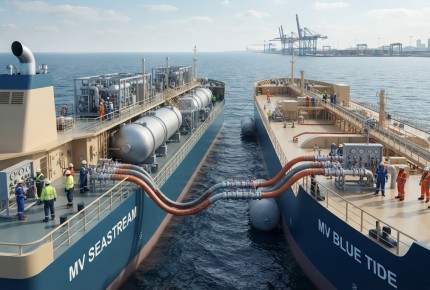
According to Dr. Su Yi, General Manager of SMDERI-QET, a partner in the initiative, project Captured has shown the feasibility of transferring captured CO₂ between ships and converting it into construction materials.
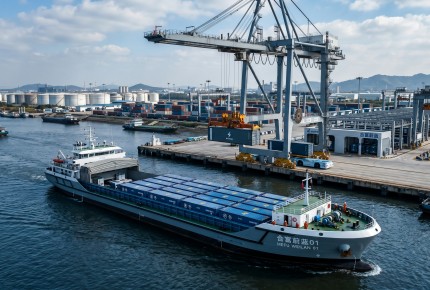
The project involved the MV Ever Top departing from Port Klang, Malaysia, where it transferred its load of captured CO₂ to the MV De jin 26 at Yangshan Port, China.
Meanwhile, the CO₂ was then transported and offloaded into a tank truck, which took it overland to Inner Mongolia. In Baotou, Mongolia, the CO₂ was utilised to produce low-carbon calcium carbonate.
The demonstration supported a proposal to the IMO’s Marine Environment Protection Committee (MEPC 84), which provided in-principle backing for recognising carbon mineralisation as a permanent CO₂ storage method. This endorsement indicates that the pathway established could be replicated, presenting a viable blueprint for reducing emissions in the shipping industry.
GCMD conducted a life-cycle assessment of its demonstration project, revealing an initial net greenhouse gas reduction of 7.9% alongside a 10.7% onboard CO₂ capture rate. The organisation noted that further optimisation could elevate total emissions reductions to 17.8%.
Although onboard carbon capture is still in the infancy of commercial deployment, recent regulatory milestones are paving the way for the incorporation of captured CO₂ into emerging maritime carbon value chains. This development is intended to synergise with other decarbonisation strategies, including low-carbon fuels and enhancements in vessel efficiency.
In 2026, significant developments in Onboard Carbon Capture Systems (OCCS) were reported. In January, the classification society DNV released a standardised framework aimed at measuring and verifying the performance of OCCS systems on ships.
Subsequently, this initiative was complemented by Japan-based ClassNK, which granted approvals in principle for two vessel concepts and enhanced its guidance regarding onboard carbon capture technologies.
Maritime Courses in London equip students with expertise in Carbon Capture and Storage (CCS), covering the full lifecycle including capture methods (post-combustion, pre-combustion, oxy-fuel, and direct air capture), transportation (pipelines and ships), and geological storage. The curriculum emphasises chemical engineering, materials science, and the economic viability of these systems.