Subscribe to our newsletter
Copyright © 2026 lmitac.com All Rights Reserved. Contact - Terms and Conditions - Privacy Policy - Quality Policy - Vacancies - Sitemap
London Maritime Academy is a trade name for London Premier Group
version: 2.9.0
Subscribe to our newsletter
Posted On: 6/5/2026, 8:06:29 PM
Last Update: 6/5/2026, 8:06:29 PM
Negotiations between Iran and the United States are ongoing, though both sides have made misleading statements regarding their progress. Information leaks appear to be intended to influence the talks rather than to provide accurate updates.
Notably, it is anticipated that both parties are initially striving for an extension of the ceasefire, which would allow for further negotiations, along with some effort to reopen the Strait of Hormuz.
Both President Trump and Iran appear motivated to settle, with Trump aiming to bolster his political stance ahead of the midterm elections.
Meanwhile, Iran seeks urgent relief from severe economic sanctions and blockades that could provoke internal unrest if not addressed promptly.
Concerns exist regarding the satisfaction of Israel and the Gulf States with any bilateral agreements between Iran and the United States, as these external parties may attempt to undermine such agreements unless threats are mitigated and navigation in the Strait of Hormuz is restored.
Moreover, this document warns that extending the ceasefire may lead to instability, particularly if either Iran or the United States is involved in managing the Strait of Hormuz amid an influx of shipping traffic.
Oman will manage traffic in the Strait of Hormuz from its naval Hormuz Control station on Didamar island, with both the inward and outward channels of the Traffic Separation Scheme (TSS) located within its territorial waters.
Oman, aiming to maintain neutrality while adhering to the International Maritime Organisation's (IMO) 1966 Strait of Hormuz Traffic Separation Scheme (TSS), is prepared to manage maritime traffic through the Strait from its Hormuz Control station located on Didamar Island, situated centrally within the Strait.
This involves overseeing both the inward and outward channels of the TSS, which are positioned within Omani territorial waters. However, clearing the water from the threat of mines is a very different story.
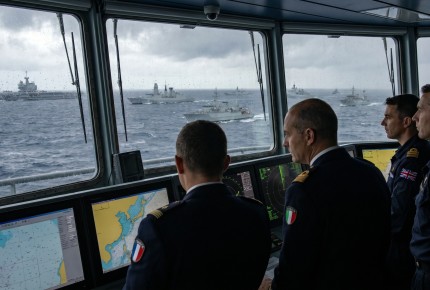 Mine Scare Mobilises 40-Nation Force
Oman's Maritime Security Centre issued a warning on May 29 about a potential sea mine near the northern channel of the Traffic Separation Scheme (TSS), urging vessels to remain vigilant and report any suspicious objects.
Subsequent reports indicated that around 20 possible mines were detected in high-resolution satellite imagery. Ship owners are likely to seek guarantees that the TSS navigation channels are clear of mines before resuming operations.
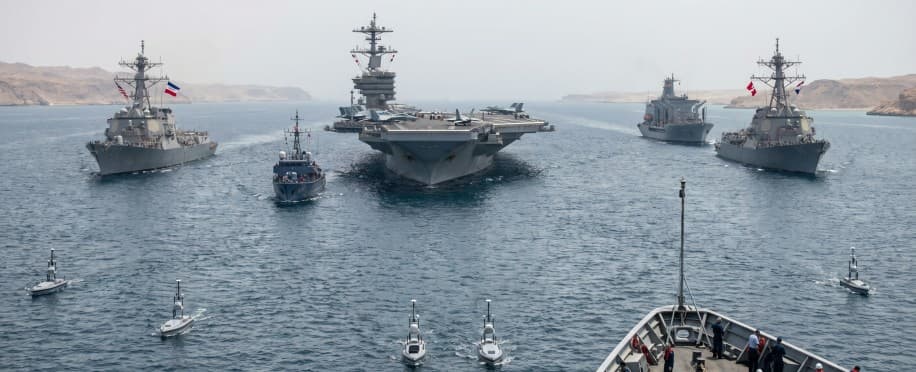
A naval force, coordinated by an Anglo-French coalition and comprising over 40 nations, is preparing for mine clearance operations. The flagship of this operation is expected to be the French aircraft carrier FS Charles de Gaulle (R91), currently stationed in the Arabian Sea alongside escorts such as the Royal Navy air defence destroyer HMS Dragon (D35).
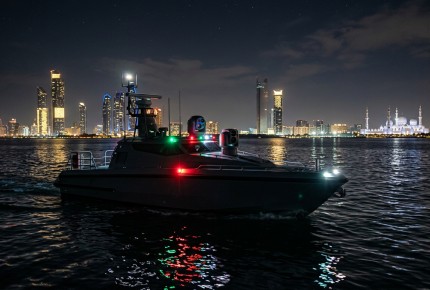
The UK's RFA Lyme Bay (L3007) is expected to serve as the primary mothership for deploying autonomous mine clearance drones. It loaded British equipment in Gibraltar on May 26 and arrived in Toulon on May 30 to load French equipment. The vessel's design, featuring a well deck and bow and azimuth thrusters, makes it well-suited for this role.
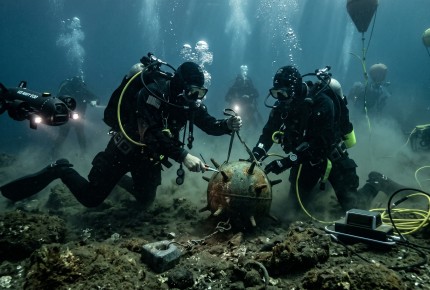
Maritime Safety Courses in London examine mine-clearing missions, analysing the threat environment, which includes suspected mine types and detection limits. It also requires coordination among multinational naval forces and utilises various clearance methods, integrating ships, drones, and support vessels to restore safe navigation routes.
More conventional mine clearance capabilities are being provided by the Italian Navy's ITS Crotone and ITS Rimini, supported by the patrol vessel ITS Montecuccoli, all of which departed for the Gulf in mid-May. The Dutch minesweeper HNLMS Willemstad was near Gibraltar on June 4.
Further, the German Defence Minister Boris Pistorius has announced the deployment of the minesweeper FGS Fulda to the Mediterranean, supported by an air defence frigate and the replenishment ship FGS Mosel, along with a maritime surveillance aircraft, prepared to enter the Gulf when conditions permit.
Many nations, particularly from Asia, are prepared to join the force, although the integration of non-NATO ships is expected to occur later, following the establishment of command-and-control structures. Once activated, many vessels will utilise the shore and replenishment facilities at Duqm port, which are equipped for this purpose and available for short-term leasing.
Read more news: