Subscribe to our newsletter
Copyright © 2026 lmitac.com All Rights Reserved. Contact - Terms and Conditions - Privacy Policy - Quality Policy - Vacancies - Sitemap
London Maritime Academy is a trade name for London Premier Group
version: 2.9.0
Subscribe to our newsletter
Posted On: 6/12/2026, 5:50:15 PM
Last Update: 6/12/2026, 5:50:15 PM
With the launch of a nuclear-powered logistics hub idea, Chinese shipbuilder Jiangnan Shipyard has broadened its ambition for nuclear-powered maritime transport.
The project, which was unveiled during Posidonia in Athens, is a step forward from the company's earlier work on nuclear-powered containerships by presenting a more comprehensive framework that integrates vessel support, cargo movement, and energy generation into a single integrated system.
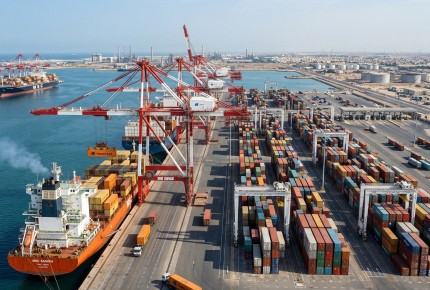
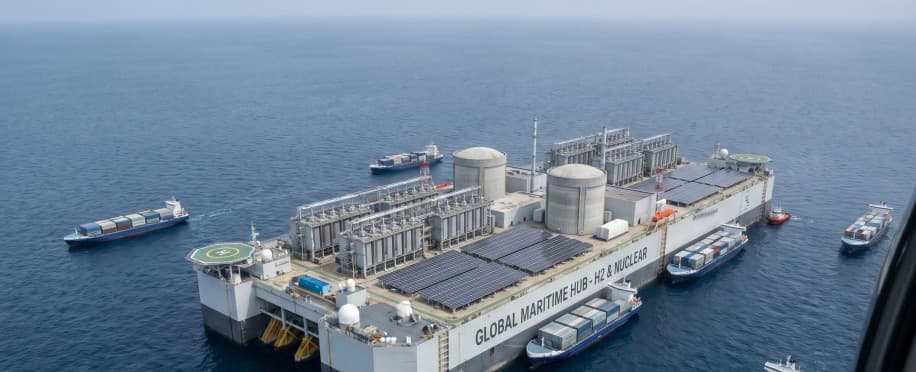
The nuclear floating logistics hub is intended to serve as a container transhipment terminal, an energy production centre, and a charging station for future vessels travelling throughout an integrated maritime network.
An offshore floating platform driven by molten salt reactor (MSR) technology lies at the heart of the idea. The platform would generate electricity for a variety of uses, such as powering ships in the network and promoting the manufacture of green fuels.
Moreover, the nuclear floating logistics centre is a component of a prospective zero-emission ocean container logistics ecosystem that aims to promote the long-term decarbonisation of international shipping, according to Jiangnan Shipyard.
Nuclear-powered deep-sea containerships, offshore container transfer terminals, pure-electric feeder vessels, and green fuel production facilities would all be integrated into the proposed system.
Additionally, large nuclear-powered boxships would travel long distances under the proposed structure, and offshore transhipment centres would distribute goods via smaller feeder vessels that operated on electricity or alternative fuels like ammonia.
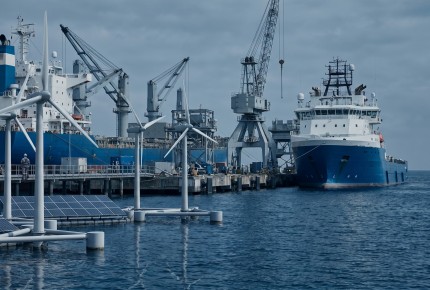
The floating platform would include renewable energy resources like solar panels and wind turbines in addition to nuclear energy production. The design also incorporates green fuel manufacturing and hydrogen production, strengthening the nuclear floating logistics centre's function as a multifunctional marine energy hub.
Maritime Online Courses investigate nuclear-powered floating hubs for zero-emission shipping; this calls for an interdisciplinary approach. Prioritising clean fuel synthesis, international safety rules, maritime logistics, and Small Modular Reactor (SMR) technology are key areas of focus.
China Advances a New Nuclear Ship Concept
Jiangnan presented a 24,000 TEU nuclear-powered containership design at Marintec China in 2023, which was followed by the most recent proposal. Based on fourth-generation molten salt reactor technology, the classification society DNV approved the vessel design in principle.
By acquiring production and installation licenses for equipment for small floating reactors and related nuclear systems from China's nuclear safety regulators earlier this year, the shipyard further solidified its position in the nuclear industry.
According to Jiangnan's new concept, nuclear power can be used for more than only ship propulsion; it can also be used for the broader expansion of maritime energy infrastructure.
Furthermore, the company is presenting nuclear technology as a potential facilitator of shipping, port operations, and fuel generation through the nuclear floating logistics centre.
There are still issues with regulation, international agreements, port access, public acceptance, and operational control, despite the fact that interest in nuclear propulsion is growing as the industry works toward long-term decarbonisation targets.
Subsequently, the plan shows how top Chinese shipbuilders are exploring options beyond alternative fuels and thinking about what a fully integrated zero-carbon maritime supply chain might look like in the coming decades, even though the floating nuclear port is still in the concept stage.
Read more news: